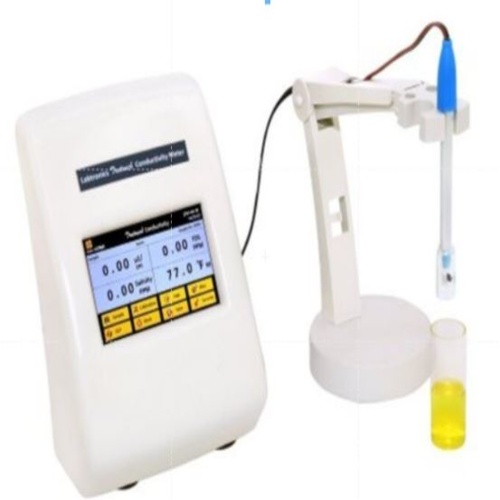
About Microprocessor Based Conductivity Tds Meter
The
DD Lab Microprocessor Based Conductivity-TDS Meter is a precision laboratory instrument for simultaneous measurement of electrical conductivity (EC), Total Dissolved Solids (TDS), and temperature. Equipped with advanced microprocessor technology for stable, accurate readings, it features automatic range selection, temperature compensation, and selectable cell constant. A clear 162 LCD alphanumeric display shows EC, TDS and temperature values simultaneously. The unit supports automatic calibration and provides high resolution (0.1 ppm/S) with accuracy within 0.5% of range. The meter includes a platinum conductivity probe, stainless electrode, temperature sensor, and is powered by 230 V AC (50 Hz). Ideal for water quality testing in labs and industries.
Accurate Water Quality MeasurementThis microprocessor-based meter is designed to provide highly accurate conductivity, TDS, and temperature readings. Suitable for demanding laboratory and industrial settings, it offers a wide range of measurements and automatic features to enhance reliability and ease of use, supporting efficient monitoring and control of water quality.
User-Friendly Automatic FeaturesFeaturing automatic range selection, temperature compensation, and calibration, the device minimizes manual intervention. The selectable cell constant allows adaptability to different kinds of water samples, ensuring versatility without compromising on performance.
Durable and Adaptable DesignConstructed with corrosion-resistant materials and a robust ABS plastic enclosure, the instrument withstands harsh environments. Its compact, lightweight make combined with a clear LED display ensures convenient operation, portability, and longevity for everyday laboratory and industrial needs.
FAQ's of Microprocessor Based Conductivity Tds Meter:
Q: How do I calibrate the Microprocessor Based Conductivity TDS Meter?
A: Calibration is conducted automatically using a standard solution. Simply connect the conductivity cell with Pt electrode, immerse it in the standard solution as per the instructions, and follow the prompts on the meter for precise calibration.
Q: What applications is this meter suitable for?
A: The meter is ideal for water quality testing in laboratories and industrial settings, including environmental monitoring, wastewater treatment, and process control due to its wide measurement ranges and reliable accuracy.
Q: When should I select a different cell constant (0.1, 1.0, or 10.0)?
A: Select a cell constant based on the expected conductivity levels of your sample. For low conductivity use 0.1, general use 1.0, and high conductivity samples 10.0. This flexibility optimizes measurement accuracy for varied sample types.
Q: Where can this meter be installed or used?
A: It can be utilized in laboratories, industrial facilities, water treatment plants, or any environment requiring precise conductivity and TDS analyses, thanks to its durable, corrosion-resistant enclosure and compact design.
Q: What is the benefit of the auto ranging and automatic temperature compensation features?
A: Auto ranging ensures the meter automatically selects the optimal range for accurate readings, while automatic temperature compensation (ATC) corrects for temperature effects (0C to 100C), enhancing reliability in diverse conditions.
Q: How does the meter indicate measured values?
A: Measurement results for conductivity, TDS, and temperature are displayed on a clear 7-segment LED display, providing instant visibility of readings during use.
Q: What is the recommended operating environment for the device?
A: The meter is designed to function optimally at temperatures between 10C and 50C and up to 90% non-condensing relative humidity, ensuring reliable performance in most laboratory and industrial climates.






 Send Inquiry



 Send Inquiry

 Send Inquiry


 English
 Spanish
 French
 German
 Italian
 Chinese (Simplified)
 Japanese
 Korean
 Arabic
 Portuguese